
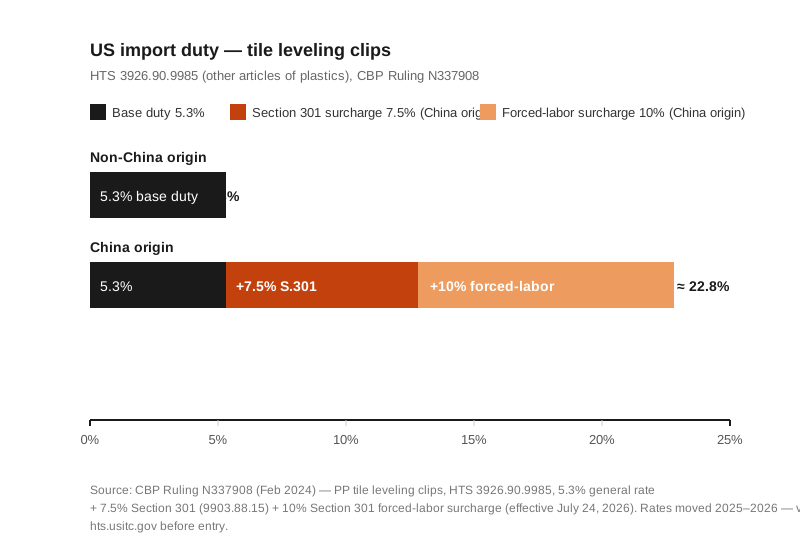
If you sell tile leveling systems, the good news is that the classification is stable and well-documented. Plastic tile leveling clips and spacers are, in the overwhelming majority of rulings and shipment data, "other articles of plastics" under HS heading 3926 — specifically 3926.90 — rather than 3923 (packaging) or 3925 (builders' ware). A U.S. Customs ruling (N337908, Feb 2024) placed PP tile leveling clips at 3926.90.9985 at a 5.3% base duty. China-origin goods now also face a 7.5% Section 301 surcharge plus a 10% Section 301 forced-labor surcharge (effective July 24, 2026, replacing the expired Section 122 tariff) — about 22.8% combined as of Aug 2026. That surcharge is being litigated, so confirm the current Chapter 99 code before entry. The UK's tariff service ruled plastic levelling clips under 3926909790 (2023), and global export trade data shows 39269099 as the single most-used HSN code across more than 7,800 shipments by 1,700+ importers (Volza, retrieved Aug 2026).
Bottom line: if you are importing tile leveling clips, wedges, or clamps into the US, classify them at 3926.90.9985 (5.3% base + 7.5% Section 301 + 10% forced-labor surcharge ≈ 22.8% total on China-origin goods as of Aug 2026); in the UK use 3926909790; and globally expect 39269099. Confirm the current rate at hts.usitc.gov before every shipment, because plastic-article tariffs have moved in 2026. The code itself is the reliable part — the percentage is what you check.
What Tile Spacer HS Code Do Leveling Clips Use?
Here is the classification you will actually encounter across markets, with the sources behind each number:
| Market | HS / HTS code | Duty (China origin) | Source |
|---|---|---|---|
| United States | 3926.90.9985 | ≈ 22.8% (5.3% + 7.5% S.301 + 10% forced-labor) | CBP Ruling N337908 (Feb 2024) |
| United Kingdom | 3926909790 | Per UK Integrated Tariff | UK Advance Tariff Ruling 600005347 (2023) |
| Global (HSN) | 39269099 | Country-dependent | Volza trade data, 7,800+ shipments (Aug 2026) |
| Alternate (some shippers) | 3925.90 / 3923.90 | Varies — verify | Volza; also seen in real importer queries |
Classification and duty rates are public tariff data retrieved Aug 2026. Section 301 rates for plastics changed through 2025–2026; always confirm the current Chapter 99 subheading at the time of entry.
One note on the alternatives: importers do occasionally clear tile spacers under 3925.90 (builders' ware of plastics) or 3923.90 (packaging), and both appear in real-world shipment data and in the queries we see from buyers. That does not make them the safer choice. A Customs ruling that classifies the product is your strongest defense; relying on a code a forwarder "usually uses" is how reclassification notices happen. When in doubt, ask the manufacturer for their export practice — we file tile leveling clips under 3926 on every tile leveling system wholesale shipment we book.
Why Does the HS Code Matter for Your Margin?
Take a 40 ft container of tile leveling clips invoiced at $20,000 FOB. At 5.3% base duty you pay $1,060; at the 22.8% combined rate for China-origin plastic articles you pay about $4,560. The $3,500 gap is several margin points on a typical distributor sell-through — before freight, insurance, and bank fees, none of which care which code you picked.
The second cost of a wrong code is time. A CBP ruling that classifies the product takes the dispute out of your shipment; a mis-declared entry can sit in exam while your distributor's next job waits. For a business that sells seasonal install tools, a two-week hold is worse than a 2% duty difference.
Third, the marking requirement is tied to classification. Under the N337908 ruling, the outer shipping cartons marked "Made in China" are enough for import — but because clips are resold to end users in plastic bags, each individual bag must also carry the country-of-origin marking, since the end customer never sees the shipping box. That is a compliance detail that costs nothing and prevents a rejected lot.
Which Products in a Mixed Container Share the 3926 Code?
A typical import order bundles several tools in one 20 ft container — clips, tile leveling wedges, tile leveling pliers, and even an electric suction cup. Classification practice for these:
- PP/Nylon break-off clips & wedges — 3926.90 (molded plastic articles), the dominant practice.
- Reusable tension clips with steel springs — still plastic articles; steel components do not change the heading when the article's essential character is the plastic clip. Confirm with your broker.
- Plastic clamps / pliers — 3926.90 for the plastic-bodied tools; steel-and-plastic combinations may fall under 8204/8205 (hand tools) if steel is primary. Verify by composition.
- Suction cup (nylon body + NBR pad) — also a molded rubber/plastic article, typically 3926; some shippers use 3925.90. Get your manufacturer's export code and keep it consistent.
The rule of thumb: if it is a molded plastic article used in tiling, start at 3926.90 and check the national 8–10 digit extension. If steel or glass changes the essential character, re-check.
How to Calculate Your Landed Duty Cost
Three numbers you need before you compare quotes:
- FOB value — the invoice value of the goods, in USD. On a $20,000 FOB shipment, that is your base.
- Duty rate — for the US, 5.3% + Section 301 surcharges for China-origin plastic articles (7.5% + 10% forced-labor as of Aug 2026; confirm the current Chapter 99 code).
- VAT / GST on import — 20% UK VAT, 21% EU, 0–10% US depending on state; charged on CIF value plus duty, not just FOB.
Worked example (US, China origin, Aug 2026 rates): $20,000 FOB × 22.8% ≈ $4,560 duty. Freight to a US West Coast port adds roughly $2,500–3,500 for a 40 ft container, and duty applies to the CIF value. Budget about 23% of goods value for duty and another 2–4% for clearance, and your quote stays realistic end to end.
What Does Customs Actually Need From You?
Keep the paperwork that matches the code on file for five years — that is the audit window for US imports:
- Commercial invoice with the HTS code, value, and country of origin on every line.
- Manufacturer's spec sheet describing material (PP, nylon, NBR), which supports the 3926.90 essential-character argument.
- Country-of-origin marking on the shipping carton and on each retail bag (per N337908).
- Section 301 reporting — for US entries, both the 3926.90.9985 subheading and the applicable Chapter 99 code (e.g. 9903.88.15) must appear.
- Manufacturer's export HS code — the code the factory's own export declaration uses, so both sides of the transaction agree.
The classification is genuinely simple for this category — 3926.90 and its national extensions cover the overwhelming majority of tile leveling products. What changes is the rate, so treat the code as your fixed anchor and the percentage as a date-stamped variable you re-check each quarter. When you send a packing list and we quote tile leveling system wholesale pricing from Ningbo, we include the HS codes our exports actually use on the shipping documents, so your forwarder and ours are speaking the same language from day one. The full kit — clips, wedges, clamps, and suction cups — is on our tile leveling system manufacturer homepage, all sharing the same 3926 anchor.
Frequently Asked Questions
What HS code do I use for tile leveling clips shipped to the US?
Classify tile leveling clips, wedges, and clamps under 3926.90.9985 per U.S. CBP ruling N337908 (Feb 2024). It carries a 5.3% base duty, plus a 7.5% Section 301 surcharge and a 10% forced-labor surcharge for China-origin goods — about 22.8% combined as of Aug 2026. In the UK use 3926909790; globally expect 39269099.
What duty will I pay on a container of China-origin tile leveling clips?
On a $20,000 FOB shipment, the 5.3% base duty is $1,060; at the 22.8% combined China-origin rate you pay about $4,560 — a $3,500 gap. Confirm the current Chapter 99 code at hts.usitc.gov before every entry, because plastic-article tariffs moved through 2025–2026.
Do wedges, pliers, and suction cups share the same HS code as clips?
Mostly yes. PP break-off clips and wedges, reusable tension clips with steel springs, and nylon/NBR suction cups are molded plastic articles filed under 3926.90 — steel components do not change the heading when the essential character is plastic. Steel-and-plastic pliers may fall under 8204/8205 if steel is primary; verify by composition.
What customs documentation do I need to keep on file?
For US imports keep records for five years: a commercial invoice with the HTS code and country of origin on every line, a manufacturer's spec sheet on material (PP, nylon, NBR), the applicable Chapter 99 code (e.g. 9903.88.15), and country-of-origin marking on the shipping carton and on each retail bag — per ruling N337908.