
Types of Tile Spacers — the Four Shapes in One Family
The name "tile spacer" covers four different tools that share one job — holding a consistent grout line — but solve it in different places. Cross and T-shaped spacers sit between tiles and set the joint width. Y-shaped spacers also brace the four-tile intersection so the joint stays level. Horseshoe shims go underneath a tile to lift a low corner on an uneven substrate. Stock the family, not a single SKU:
| Type | SKU | Joint widths | Options | FOB / 100 pcs | MOQ |
|---|---|---|---|---|---|
| Cross | BM-T01-SPCR | 1.0–10.0mm | 8 models | $0.60–0.80 | 1,000 bags |
| T-Shaped | BM-T02-TSPR | 1.0–10.0mm | 9 sizes | $0.60–0.80 | 1,000 bags |
| Y-Shaped | BM-T03-YSPR | 1.5–4.0mm | 5 sizes | $0.50–0.70 | 1,000 bags |
| Horseshoe shims | BM-H01-SHIM | 1.5–6.5mm | 4 color codes | $0.60–0.70 | 500 bags |
⚖️ Guide prices are FOB Ningbo at MOQ and subject to raw material cost fluctuations — contact us for current pricing.
Bottom line: stock cross spacers (1.0–10.0mm) as your volume SKU, add T-shaped for wall tile, and let Y-shaped be the price-lead conversation-starter at $0.50–0.70/bag. Horseshoe shims round out the family for rework-prone substrates at a 500-bag MOQ — the lowest in the line. All four pack 100 pieces per bag and ship mixed on one container.
Cross Tile Spacers — the Floor Workhorse
Cross spacers are what most buyers picture when they say "spacers": a small cross you drop between four tiles at the corner. They are the default for floors, where gravity holds them in place while the mortar sets. Our cross tile spacers (BM-T01-SPCR) cover the full 1.0–10.0mm range across 8 models: a standard cross (23×23×2.4mm), a thick-body version for heavy tile, a large 27×27mm profile for wide joints, an adjustable model for tile 1–3mm thick, plus star, circular and U-type profiles for specialty layouts. Tolerance is ±0.1mm on every size, so a 3.0mm cross really gives a 3.0mm line.
Weight drives your freight bill as much as price does. A 100-piece bag of 1.0mm cross spacers weighs 11.5g; the same bag at 5.0mm weighs 42g — nearly four times heavier. That is why wide-joint spacers (8.0mm and 10.0mm) show up late in a container plan: they add weight faster than clips or wedges. Price stays flat at $0.60–0.80/bag across the range, MOQ 1,000 bags.
T-Shaped Tile Spacers — the Wall-Tile Specialist
T-shaped spacers add a vertical leg to the cross, so the spacer braces the tile against the substrate while the thin-set cures — the reason the T-profile exists. On walls, a plain cross lets the top tile edge drift; a T holds it flat. Our t-shaped tile spacers (BM-T02-TSPR) cover 9 sizes — 1.0, 1.5, 2.0, 2.5, 3.0, 4.0, 5.0, 8.0 and 10.0mm — on a 25×25×2.4mm PP PE body with an extended leg. Same ±0.1mm tolerance, same $0.60–0.80/bag pricing, same 1,000-bag MOQ as the cross family.
The 8.0 and 10.0mm sizes are the ones most lines skip — and the ones rustic, terracotta, outdoor paving and ledge-stone jobs need. At 10.0mm, a 100-piece bag weighs 122g, so these are weight-heavy in freight just like wide cross spacers. For standard wall tile, 1.5–2.0mm is the common order; 2.0–3.0mm covers large-format wall panels.
Y-Shaped Tile Spacers — the Leveling Spacer
Y-shaped spacers look like a cross with two arms fused into a Y, and the geometry does something the other spacers cannot: the two spread legs seat across the four-tile cross joint and hold the intersection in one plane, so the Y spaces and levels at the same time. Our y-shaped tile spacers (BM-T03-YSPR) are 25×25×3.15mm in 5 sizes — 1.5, 2.0, 2.5, 3.0 and 4.0mm — and the cheapest spacer in the family at $0.50–0.70/bag, MOQ 1,000 bags.
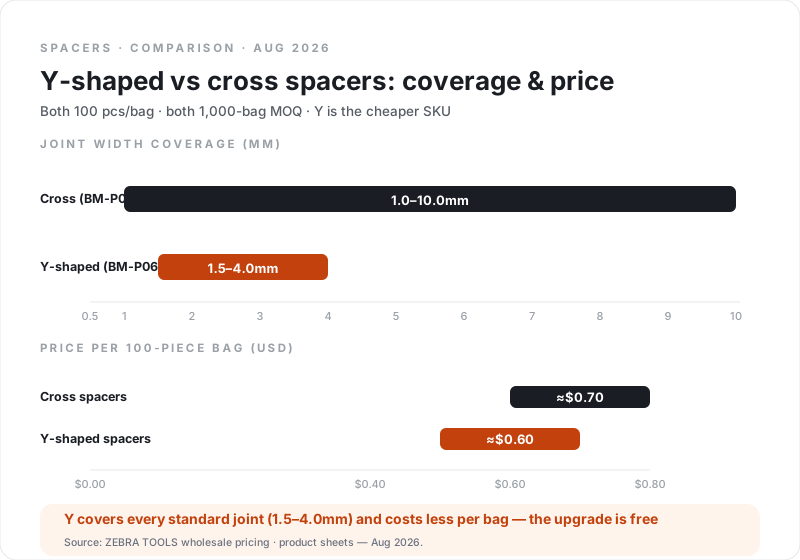
The 1.5–4.0mm band covers the contemporary floor standard (2.0–3.0mm) plus the 4.0mm rustic look. For extremes — 1.0mm glass-mosaic joints or 8.0–10.0mm outdoor paving — use cross or T-shaped spacers, both of which reach 10.0mm. Where lippage at the corner matters more than the joint width itself, the Y is the upgrade that costs you nothing.
Horseshoe Shims — the Substrate Fix in the Same Family
Horseshoe shims are not spacers — they are the family member that fixes what the substrate did wrong. Where cross, T and Y spacers sit between tiles to set a line, a horseshoe shim slides under a low tile edge and lifts it, correcting lippage caused by an uneven floor or wall before the leveling clips take over. The open horseshoe shape leaves a clear path for thin-set and stays embedded without trapping air.
| Color code | Thickness |
|---|---|
| Blue | 1.5mm |
| Red | 3.0mm |
| Yellow | 5.0mm |
| Black | 6.5mm |
Our horseshoe shims (BM-H01-SHIM) come in four color-coded thicknesses from 1.5mm to 6.5mm in polypropylene, 100 pcs/bag, at $0.60–0.70/bag. They stack — 3.0 + 1.5 = 4.5mm — when one size is not enough. MOQ is 500 bags, the lowest in the whole leveling line, which makes shims the easiest first SKU to trial.
Which Tile Spacer Should You Stock?
If you are building a spacer line for the first time, the practical order is:
- Cross spacers — the volume SKU. 2.0 and 3.0mm cover most floor jobs; add 1.5mm for walls.
- T-shaped spacers — for wall tile and any tile that needs bracing while adhesive cures. 1.5 and 2.0mm are the fast movers.
- Y-shaped spacers — the price-lead at $0.50–0.70/bag and the corner-leveling option. 2.0–3.0mm.
- Horseshoe shims — for the rework-prone customer with uneven substrate. Carry all four colors from 500 bags.
Every container mixes these four freely — spacers and shims pack denser than clips, and we calculate exact loading plans per order.
How to Buy Tile Spacers Wholesale
Because all four types share the same 100-piece bag unit and China FOB origin, you can combine them on a single wholesale order — the full price book runs cross and T-shaped at $0.60–0.80/bag, Y-shaped at $0.50–0.70, horseshoe shims at $0.60–0.70. Order rules to plan around:
- MOQ by product — spacers 1,000 bags each, shims 500 bags. Orders over $2,000 waive per-product MOQs.
- Weight drives freight — a 10.0mm T bag weighs 122g vs 10g at 1.0mm. Wide sizes cost more per bag to ship than they cost to buy.
- Custom colors & OEM — any Pantone color on a 5,000-bag custom run; private-label bags and retail packaging available on the same order.
- Samples first — free samples ship in 3–5 days via DHL/FedEx so your installers can test the spacer profile before the container sails.
That is the whole family: cross and T-shaped for the joint, Y-shaped for the level corner, horseshoe shims for the substrate. Spacers are the highest-margin easy add-on to a China tile leveling system manufacturer order — they turn a clip-and-wedge buy into a full kit in the same container space.
Frequently Asked Questions
What are the different types of tile spacers?
Four types make up a complete line: cross spacers (BM-T01-SPCR, 8 models, joints 1.0–10.0mm) for floors, T-shaped spacers (BM-T02-TSPR, 9 sizes, extended leg) for wall tile, Y-shaped spacers (BM-T03-YSPR, 5 sizes, 1.5–4.0mm) that lock the cross joint level, and horseshoe shims (BM-H01-SHIM, 4 color codes, 1.5–6.5mm) that fix low spots under the tile. All are 100 pcs/bag; spacers run $0.50–0.80/bag, shims $0.60–0.70/bag.
What size tile spacers do I need for floors and walls?
For floors, 2.0–3.0mm is the contemporary standard; 4.0mm covers rustic looks. For walls, 1.5–2.0mm is common, and 2.0–3.0mm suits large-format wall panels. Use 1.0mm for glass mosaic and 5.0–10.0mm for outdoor paving and ledge stone. Cross and T-shaped spacers both cover the full 1.0–10.0mm range; Y-shaped spacers cover 1.5–4.0mm.
How much do tile spacers cost wholesale?
Factory-direct FOB Ningbo, 100-piece bags run $0.60–0.80 for cross and T-shaped spacers, $0.50–0.70 for Y-shaped spacers (the cheapest in the family), and $0.60–0.70 for horseshoe shims. MOQ is 1,000 bags per spacer type and 500 bags for shims; orders over $2,000 waive per-product MOQs.
What is the difference between T-shaped and cross tile spacers?
Both set the same 1.0–10.0mm joint range, but a T-shaped spacer adds an extended leg that braces wall tile against the substrate while thin-set cures — a plain cross lets the top edge drift on a wall. T-shaped spacers are the wall-tile specialist; cross spacers are the floor default. Y-shaped spacers add corner leveling on top of spacing.