
Bottom line: Germany imports under EU TARIC rules: HS 3926.90, 19% VAT, EORI mandatory, CE required + TÜV differentiator. Hamburg is 30-38 days from Ningbo. The three products that matter for the German market are clips (consumable, 55% of volume), wedges (high-margin accessory, 25% of volume), and Spin Doctor (wall tile specialist, 10-15% of volume). A 500-bag LCL trial order costs roughly €820-1,150 landed. Compete on documentation and certification, not price — the German market rewards quality signals over discounts.
Hamburg runs 30-38 days from Ningbo, and the mix that sells is 60% clips, 30% wedges, 10% Spin Doctor.
1. Germany Market Snapshot — Why Tile Leveling Demand Is Strong
Germany builds roughly 300,000 new housing units annually, with renovation activity in the existing 43 million housing stock driving steady tile installation demand. German tilers (Fliesenleger) are among the most certification-conscious in Europe — they expect CE marking and increasingly recognize TÜV Rheinland as the credibility benchmark. A distributor who can show TÜV certification on their tile leveling products has an immediate competitive advantage over suppliers offering only CE self-declaration.
The market has shifted toward large-format tiles (60×120cm and larger) in both residential and commercial projects. This trend directly increases demand for leveling systems — large tiles are far less forgiving of substrate unevenness. German contractors have also been early adopters of Spin Doctor twist-to-level systems for wall installation, where the tool-free mechanism reduces installation time by 30-40% compared to traditional clip-and-wedge.
2. Germany Import Basics — 5 Things to Know
1. HS Code 3926.90. Other articles of plastics cover tile leveling clips, tile leveling wedges, cross tile spacers, and horseshoe shims. Germany applies EU TARIC duty rates — verify the exact percentage for your subheading at Zoll.de (German Customs online tariff database). Plastic building products under HS 3926.90 carry 6.5% duty for China-origin goods. VAT is 19% (Mehrwertsteuer), calculated on CIF value + duty. Sources: hs.bianmachaxun.com — Germany import rates, Feb 2025
2. EORI number is mandatory. Any business importing goods into Germany from outside the EU must register for an EORI (Economic Operators Registration and Identification) number. Registration is free via the German Customs portal (Zoll.de) and takes 5-10 business days. Your freight forwarder cannot clear customs without it.
3. CE marking is required. TÜV is your differentiator. Tile leveling tools sold in Germany must carry CE marking — this is non-negotiable for EU market access. However, CE is a self-declaration. TÜV Rheinland certification — verifiable on certipedia.com — is the credibility signal that German buyers recognize and trust. Our factory holds both: CE (4 certificates) and TÜV Rheinland factory certification with annual on-site audit.
4. De minimis threshold. Consignments with FOB value ≤ €150 remain exempt from customs duty. The old €22 VAT exemption was abolished in July 2021 — import VAT of 19% now applies to every commercial shipment regardless of value. A 5-10 bag sample order still slips under the €150 duty threshold — an easy way to test product quality before committing to wholesale volumes.
5. VerpackG — Packaging Act registration. Germany's Packaging Act (Verpackungsgesetz) requires any business placing packaged goods on the German market to register with the Zentrale Stelle Verpackungsregister (ZSVR). This applies to importers. Registration is straightforward and costs roughly €30-150/year depending on packaging volume. Most customs brokers can handle this as part of the clearance process. Source: airsupplycn.com — China-Germany import guide
3. Top 3 Products for the German Market
Based on order patterns from our Wenzhou factory to German distributors, three products consistently dominate demand:
| Product | SKU | MOQ | German Market Fit |
|---|---|---|---|
| Tile Leveling Clips | BM-021, 10 models | 500 bags | ~55% of order volume. Consumable — 1.5mm and 2.0mm are the most common sizes in Germany. Compatible with Raimondi, Rubi, QEP — German tilers are brand-aware and expect universal compatibility. |
| Tile Leveling Wedges | BM-C01, 11 models | 500 bags | ~25% of order volume. Reusable PE, 100+ cycles. Highest margin accessory (60-75% gross margin at distributor pricing). German contractors value durability — the 100+ cycle rating matters more here than in price-sensitive markets. |
| Spin Doctor Tile Leveling System | BM-S01, 2 models | 500 bags | ~10-15% of order volume. Preferred for wall tile installation — 30-40% faster than clip-and-wedge, no hammering required. German contractors value speed and precision on wall work. CE certified (B-S03025E3982). |
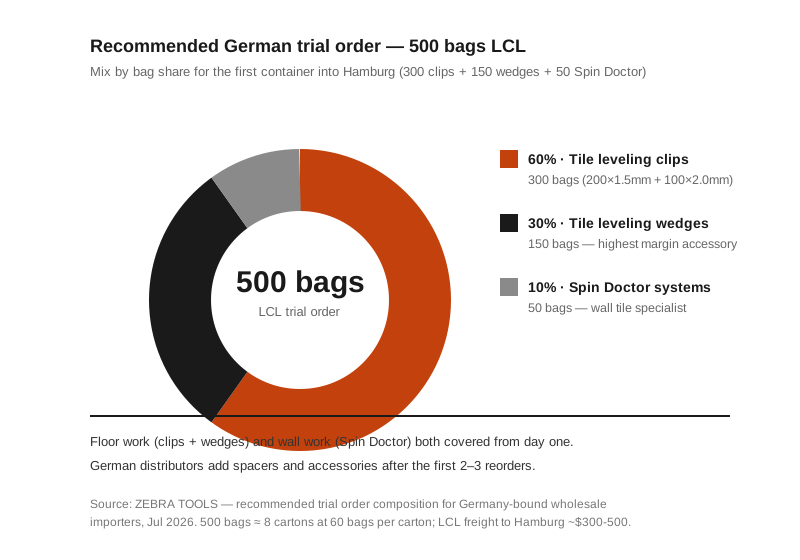
German distributors typically structure their first order at 60% clips, 30% wedges, 10% Spin Doctor. This covers the full range of professional tile installation — floor work (clips + wedges) and wall work (Spin Doctor). Spacers and additional accessories are added after the first 2-3 reorders, once customer demand patterns are clear.
4. Port Comparison — Hamburg vs Bremerhaven vs Rotterdam
| Port | Ningbo Transit | Clearance | Inland to Central Germany | Best For |
|---|---|---|---|---|
| Hamburg | 30–38 days | 2–3 days | 1–2 days (rail/truck) | Northern & Central Germany |
| Bremerhaven | 32–40 days | 2–3 days | 1–2 days | Alternative North German port |
| Rotterdam (NL) | 30–40 days | 1–2 days | +1 day (cross-border truck) | Western Germany, Ruhr region |
Hamburg is the default choice — Germany's largest port, handling roughly 9 million TEU annually. Rotterdam is slightly farther from Ningbo at 30-40 days and adds cross-border trucking into Germany. For distributors based in North Rhine-Westphalia (Düsseldorf, Cologne, Dortmund), Rotterdam + truck can still be competitive door-to-door, avoiding the German rail leg — compare both options with your freight forwarder. Sources: topchinafreight.com, fluctcargo.com — China-Germany transit times 2025
5. Container Costs & Trial Order Recommendation
⚖️ Guide prices are subject to raw material cost fluctuations — contact us for current pricing.
| Route | 20ft (Freight) | 40ft HQ (Freight) |
|---|---|---|
| Ningbo → Hamburg | ~$2,000-3,000 | ~$3,500-5,000 |
| Ningbo → Rotterdam | ~$1,800-2,800 | ~$3,200-4,500 |
Recommended trial order (LCL): 300 bags clips (200×1.5mm + 100×2.0mm) + 150 bags wedges + 50 bags Spin Doctor = 500 bags total. This is roughly 8 cartons at 60 bags per carton. LCL freight to Hamburg: ~$300-500. Total landed cost with duty and VAT: roughly €820-1,150. At 35-55% distributor markup, sell-through generates €290-630 gross margin — and the real value is discovering which sizes sell fastest for your second order. Source: ZEBRA TOOLS landed-cost model — EU TARIC 6.5% duty on CIF + 19% VAT on duty-inclusive base, LCL China→North Europe rates. Aug 2026.
Germany is not a price-first market. German buyers will pay a premium for documented quality — TÜV certification, batch traceability, material certificates. A distributor who competes on documentation rather than price captures higher margins and lower churn. Read our tile leveling system wholesale pricing for the full per-line calculation.
6. 3 Distribution Strategies for Germany
1. Supply Fachhandel (specialist tile and building materials retailers). Germany has a dense network of independent Baustoffhändler and Fliesenfachgeschäfte — roughly 4,000+ specialist tile retailers nationwide. These retailers value certification documentation (TÜV, CE, RoHS), consistent product quality, and reliable delivery. Margins are 30-40% and reorder cycles are 6-8 weeks for consumables. Relationship-driven: expect to provide product data sheets in German (DIN format preferred) and offer Muster (physical samples) before a first order.
2. Amazon DE + eBay DE B2B. German tradespeople increasingly purchase consumables online. An Amazon DE Professional Seller account with FBA reaches roughly 45 million German Amazon users. The "Fliesenverlegewerkzeuge" category on Amazon DE has moderate competition — a well-optimized listing with German-language product descriptions and TÜV badges stands out. Combine Amazon DE with your own Shopify store (German-language, EUR pricing) for a complete online strategy. See our tile leveling system OEM program.
3. OEM private label for German Baumarkt chains. Germany's home improvement chains (Bauhaus, OBI, Hornbach, Toom) increasingly seek private-label suppliers for professional tool accessories. A TÜV-certified factory-direct OEM program with Pantone color matching, German-language packaging, and CE documentation meets their procurement requirements. MOQ starts at 500 bags per SKU, with 15-25 day OEM production lead time. Read our tile leveling system OEM page for the end-to-end process.
Frequently Asked Questions
What import duty and VAT apply to tile leveling systems in Germany?
Clips, wedges, spacers and shims classify under HS 3926.90 under EU TARIC rules — for Chinese-origin goods the EU TARIC subheading 3926.90.97 carries an MFN duty of 6.5%. VAT (Mehrwertsteuer) is 19%, calculated on CIF value plus duty. Verify the exact percentage for your subheading at Zoll.de (German Customs).
Do I need an EORI number to import into Germany?
Yes — an EORI (Economic Operators Registration and Identification) number is mandatory for any business importing into Germany from outside the EU. Registration is free via the German Customs portal (Zoll.de) and takes 5-10 business days. Your freight forwarder cannot clear customs without it.
Is CE marking enough, or do I also need TÜV certification?
CE marking is mandatory for EU market access, but it is a self-declaration. TÜV Rheinland certification — verifiable on certipedia.com — is the credibility signal German buyers recognize and trust. A distributor who can show TÜV certification has an immediate advantage over suppliers offering only CE self-declaration.
What is the de minimis threshold, and what does a trial order cost?
Consignments with FOB value up to €150 are exempt from customs duty — that de minimis threshold still applies. The old €22 VAT exemption was abolished in July 2021, so 19% import VAT now applies to every commercial shipment regardless of value. Sample orders of 5-10 bags still clear the €150 duty threshold. A 500-bag LCL trial order (300 bags clips, 150 wedges, 50 Spin Doctor) runs about $300-500 in LCL freight to Hamburg and roughly €820-1,150 total landed cost with duty and VAT.